Saturday, December 28, 2013

Only 3 days left!


Only 3 days left to take advantage of our Special Holiday Membership rate! We don't want you to miss out on the lowest price we've ever offered.


Test the service with this special rate of $89 for 3 months of MarketClub (a 40% savings!) and have more time to see how MarketClub can benefit your trading in the new year.


• Scan for potential trades and charting setups with Smart Scan

• Determine entry and exit points with the Trade Triangles

• Know when to make a move with our Email Alerts

• Apply technical indicators and more with our Chart Technology

And much more...


Let MarketClub help you prepare your 2014 trading plan with the right tools for the job.


*This offer is only valid for new or returning customers. If you are a current member, we have a special renewal offer for you too! Members must contact the Support Team to access this special holiday savings.


Happy Holidays!

The MarketClub Team

support@ino.com

1-800-538-7424


PS. For the holidays, our offices are closed until January 2nd. So, if you prefer to call us to take advantage of this offer, please leave us a voicemail with your name and email address and we'll honor the holiday pricing when we return. See you in 2014!


news

Power regulators blink


AFP FILE PHOTO


Amid the growing public anger over the record rise in electricity rates, government regulators on Saturday decided to set a lower price cap for electricity being traded on the Wholesale Electricity Spot Market (WESM) while authorities are studying how to prevent power rates increases in the future.


The cap refers to the highest possible price that can be offered by power-generating companies selling their excess capacity on the WESM.


In a joint resolution with the Department of Energy (DOE) and the spot market operator, the Philippine Electricity Market Corp. (PEMC), released on Saturday, the Energy Regulatory Commission (ERC) set the new offer price ceiling on the WESM at P32,000 per megawatt hour (mWh), from the current P62,000 mWh, or P32 per kilowatt-hour (kWh), from the current P62/kWh.


The ERC, DOE and PEMC make up the WESM tripartite committee that monitors price volatilities on the spot market.


Regulators said the new ceiling would be in effect until the issuance of a new offer price cap “not later than 90 days” from the issuance of the joint resolution that was signed on Dec. 27.


Protests have greeted the huge increase in household electricity rates in Metro Manila and neighboring areas over the next three months from December, which power distributor Manila Electric Co. (Meralco) announced early this month.


Meralco explained the unprecedented P4.15/kWh increase in the generation charge as the result of a monthlong maintenance shutdown of the Malapaya natural gas plant in November/December as well as the unscheduled shutdown of other power plants, forcing it to source more of its power needs from the WESM where prices were higher than the Malampaya natural gas.


The WESM was created following the restructuring of the energy sector under the Electric Power Industry Reform Act (Epira) of 2001 for power suppliers to trade energy outputs and agree on prices.


The price paid is based on the last offer made to meet the demand, although a ceiling (called the “bid cap” or “price cap”) is set.


The spot market is designed so that distributors like Meralco and other buyers can get additional supply whenever electricity demand is higher than what the distributors have contracted for with power plant operators.


Pricing study ordered


Lowering the price that consumers have to pay for power is the main reason for the WESM’s creation. However, the spot market has been plagued by persistent price problems, culminating in spikes in the prices of traded electricity units from power generators last June.


The ERC has directed the PEMC to submit a study on the “appropriate” offer price cap within 30 days from the issuance of the Dec. 27 resolution. Hence, the new offer price cap is temporary and will remain in place only while the WESM pricing study is going on, the ERC said.


According to state regulators, the PEMC is already studying how to deal with several market design and implementation issues that recently became a hot topic with the record P4.15/kWh increase in the generation rate that Meralco will pass on to its customers in three phases starting this month.


Regulators noted during the period of the Malampaya shutdown that WESM prices were reaching the maximum offer price cap of P62/mWh “more often than usual and even during off-peak hours when demand for electricity is low.”


The resulting high market prices may have translated into considerable increases in Meralco’s and other distributors’ generation charges, which are passed on to electricity consumers, depending on the level of bilateral contracts and/or exposure on the WESM.


Market-driven


As the controversy over the Meralco power rate increase raged, the WESM tripartite committee convened on Dec. 13 to discuss possible adjustments to the offer price ceiling. On Dec. 20, the committee agreed to put in place procedures and measures to deal with extreme price spikes or prolonged price volatility, in another meeting on the resolution to lower the price cap which took place on Dec. 27.


The new cap is based on the recently promulgated offer cap set by the WESM tripartite committee for the commercial operation of the Interim Mindanao Electricity Market.


“The new and revised offer price cap will be subjected to a public consultation and will be subject to the regular review and adjustments by the WESM tripartite committee,” the joint resolution said.


PEMC president Melinda Ocampo earlier explained that WESM prices are market-driven, such that if there is sufficient power, buyers such as Meralco can even get lower prices than their bilateral contracts.


“If there is insufficient supply or scarcity, that’s when prices go up,” Ocampo said.


Fears of a whitewash


Militant party-list lawmakers meanwhile are suspicious that the DOE’s investigation into the alleged collusion of power generators in the uncommonly high electricity rate increases could end up in a whitewash.


Party-list Representatives Neri Colmenares and Carlos Isagani Zarate (Bayan Muna) said they were concerned over Energy Secretary Jericho Petilla’s reported statement that he wanted Meralco to appeal the Supreme Court’s temporary restraining order (TRO) stopping the P4.15/kWh rate increase.


Petilla was quoted as saying that Meralco may have to borrow money to pay for power purchases, which he said could lead the distributor into charging higher electricity rates to pay off interest costs.


Colmenares said Petilla—whose offer to resign over his supposed failure to restore electricity to 100 percent of areas struck by Supertyphoon “Yolanda” has been rejected by President Aquino


—should be replaced for his statements.


“It is clear that he (Petilla) views the extremely high power rate hike as aboveboard and regular,” Colmenares said in a statement.


“He should immediately be replaced because he is a threat to consumer interest,” he said.


He said Petilla’s statement indicated that he did not doubt the veracity of the computation of the rate hike, and was “practically preempting the Supreme Court and is siding with the power cartel.”


Zarate said the energy secretary had apparently turned his back on consumers affected by the “unjust” power rate hike.


“His statements totally unmasked the pretentious and misleading posturing of Secretary Petilla because in truth, he is a high-voltage defender of the now cartelized power industry. He is a protector of power oligarchs and their benefactors raking in billions of pesos from consumers. No wonder President Aquino retained his services,” he said.


The two party-list members said they were concerned that the joint DOE-ERC investigation into the alleged collusion among the power generators in the rate hikes would end in a whitewash.


Colmenares said he was optimistic the Supreme Court would strike down the Epira.


He said the justification citing the Epira for the automatic rate adjustment by distributors was unconstitutional because it did not provide for consumers challenging the rate hikes.


“We believe that our case against Meralco and the ERC would win in the Supreme Court. We have a very strong case and we think that the [court] will declare the Epira unconstitutional precisely because it does not allow consumers the due process right to question the generation charges,” he said.


Party-list members and militant groups have filed three petitions in the high court to stop Meralco from imposing the P4.15/kWh rate hike.


They are also asking the high tribunal to declare unconstitutional several provisions of the Epira, among them the sections empowering the ERC to determine, fix and approve the universal charge to be imposed on all electricity users. With a report from Leila B. Salaverria


RELATED STORIES:


Regulators lower electricity spot market bid cap


Who will regulate the regulators?


Repeal of EPIRA law pushed



seo tools

Regulators lower electricity spot market bid cap


INQUIRER.net FILE PHOTO


MANILA, Philippines – Power regulators have set a lower price cap on electricity spot market supply trades while further studies are conducted to prevent spikes in power rate.


The cap is to the highest possible price that may be offered by power generation companies trading excess capacity in the Wholesale Electricity Spot Market or WESM.


The WESM is designed in such a way that Meralco and other buyers can get additional supply of electricity whenever demand is higher than what the distribution utility contracted with power plant operators. Existing rules prioritize power suppliers with the lowest price offers for electricity buyers. However, the price paid is based on the last offer made to meet the demand, although a ceiling (called the “bid cap” or “price cap”) is set.


The Energy Regulatory Commission, in a joint resolution with the Department of Energy and spot market operator Philippine Electricity Market Corp. set the new offer price ceiling in the WESM at P32 per MWh, down from P62 per MWh.


The ERC, DOE, and PEMC make up the so-called WESM Tripartite Committee, which was created to coordinate, monitor, and mitigate price volatilities in the spot market.


Regulators said the new ceiling will be in effect until the issuance of a new offer price cap “not later than 90 days” from the issuance of the joint resolution, which was signed Friday, December 27.


The ERC directed PEMC to submit a study on the “appropriate” offer price cap within 30 days from the issuance of the resolution. As such, the new offer price cap is interim in nature and will be in place while a WESM design study is ongoing, the ERC said.


PEMC, the regulators said, was already studying how to address several market design and implementation issues that recently became hot topics in light of the record P4.15/kWh hike in power rates supposed to be passed on to customers of the Manila Electric Co. (Meralco) in three phases starting this month.


The scheduled 30-day maintenance shutdown of the Malampaya gas platform (Nov. 11 to Dec. 10) required the use of more expensive alternate fuels for the continuous operations of three natural gas-fired power plants, which were not scheduled for maintenance. However, regulators noted during that period, WESM prices were found to be reaching the maximum offer price cap of P62/MWh “more often than usual and even during off-peak hours when demand for electricity is low,” the ERC said.


The resulting high market prices may have translated to considerable increases in Meralco’s and other distribution utilities’ generation charges, which are passed on to electricity consumers, depending on the level of bilateral contracts and/or exposure in the WESM.


As the controversy over the price increase for Meralco customers raged, the WESM Tripartite Committee, on Dec. 13, convened to discuss possible adjustments to the offer price ceiling. On Dec. 20, the WESM Tripartite Committee agreed to put in place procedures and measures to address extreme price spikes or prolonged price volatility. Another meeting on the resolution to lower the price cap took place on Dec. 27.


The new cap is based on the recently promulgated offer cap set by the WESM Tripartite Committee for the commercial operation of the Interim Mindanao Electricity Market (IMEM).


“The new and revised offer price cap will be subjected to a public consultation and will be subject to the regular review and adjustments by the WESM Tripartite Committee,” the joint resolution said.


PEMC president Melinda Ocampo explained that WESM prices were market-driven, such that if there is sufficient power, buyers such as Meralco can even get lower prices than their bilateral contracts. “If there is insufficient supply, scarcity, that’s when prices go up,” Ocampo said.


Petilla to meet with power players to discuss TRO on rate hike


seo tools

AirAsia X orders 25 more A330-300s


Airline embarks on major expansion with popular Airbus widebody


AirAsia X, the long haul affiliate of the AirAsia Group, has placed a firm order with Airbus for 25 more A330-300s. The contract is the largest A330 order received by Airbus in a single purchase agreement and increases the carrier’s total firm orders for the type to 51. These will be supplemented by another six A330-300s leased from International Lease Finance Corporation (ILFC).


The contract was signed in Paris by Azran Osman-Rani, CEO of AirAsia X and Fabrice Brégier, President and CEO, Airbus, witnessed by Tan Sri Tony Fernandes, Co-founder and Director of AirAsia X.


AirAsia X will start taking delivery of its newly-ordered A330-300s in 2015 as it begins a major expansion of its network across the Asia-Pacific region. The new order includes the latest extended range versions of the A330-300, providing the carrier with the ability to offer non-stop service to destinations in Europe or one-stop service to the US.


Tan Sri’ Tony Fernandes, Co-Founder and Director of AirAsia X said, “This order stamps our firm intent to dominate the long-haul, low cost carrier space and marks the next phase in our development to be the undisputed global market leader. Our commitment would allow us to remain as the youngest wide body fleet age in the region at under five years throughout 2019, with corresponding competitive fuel efficiency, reliability and cabin comfort benefits.”


“The aircraft orders would further cater to our expansion plans in Malaysia, and the proposed new Thai AirAsia X hub as well as other long-haul ventures planned across Asia. The developments will complement the AirAsia Group’s long-term vision of developing its presence in key markets in Asia and strengthen the connectivity between long-haul and short-haul low-cost network.”


“AirAsia X has proven that it is possible to build a highly successful low cost long haul business,” said Fabrice Brégier President and CEO, Airbus. “And the A330 is the perfect platform for such operations, with the lowest operating costs, true long range flying capability and a proven track record of exceptional technical reliability. We look forward to working with AirAsia X as it continues to innovate in the low cost long haul market.”


AirAsia X currently operates 16 A330-300s on services linking its Kuala Lumpur base to destinations in Asia, the Middle East and the Pacific. In addition to A330s, the carrier also has 10 A350-XWB aircraft on order for future delivery.


The latest order from AirAsia X further consolidates the position of the AirAsia Group as one of Airbus’s largest airline customers in the world. In total the Group has now ordered 536 aircraft from the manufacturer. These include 475 A320 Family single aisle aircraft for AirAsia’s short haul operations based out of Kuala Lumpur, Bangkok, Jakarta and Manila, plus the 51 A330s and 10 A350 XWBs for AirAsia X.


Follow Us


Recent Stories:


Complete stories on our Digital Edition newsstand for tablets, netbooks and mobile phones; 14-issue free trial. About to step out? Get breaking alerts on your mobile.phone. Text ON INQ BREAKING to 4467, for Globe, Smart and Sun subscribers in the Philippines.

Short URL: http://business.inquirer.net/?p=158167


Tags: A330-300 , Air Asia Group , AirAsia X , Business


Factual errors? Contact the Philippine Daily Inquirer's day desk. Believe this article violates journalistic ethics? Contact the Inquirer's Reader's Advocate. Or write The Readers' Advocate:


seo tools

Friday, December 27, 2013

15 Hand-Picked Charts to Help You See What's Coming in the Markets


Everyone uses gas: See this chart that shows why its price is heading lower


By Elliott Wave International


Have you ever seen price charts that tell a story clearly? Here is a perfect example from Robert Prechter's most recent monthly publication, The Elliott Wave Theorist.


By combining headlines from newspapers with the price chart for retail automotive gasoline, Prechter paints a clear picture -- that you can see for yourself -- as to why gas prices will probably go much lower.


Prechter chose 14 more charts like this one to explain to his subscribers where the f inancial markets are headed in 2014. They cover markets like the S&P 500, NASDAQ, the Dow, commodities, gold, and mutual funds. With this information, they are now prepared to be on the right side of the financial markets. (And you can be, too, because, in a rare opportunity, we can offer you a look at the whole issue -- FREE.)


Prechter says that "charts tell the truth." Here is your chance to see what truths these charts are telling. If a picture is worth a thousand words, then this latest publication is like reading more than 15,000 words of his market analysis.


Pointer: Be sure to check out one of the coolest charts, which shows how Main Street investors actually see the markets better than Wall Street. For a limited time, you can read the full issue for free. Read below for details.


Prepare for 2014 with a complimentary issue of The Elliott Wave Theorist

Give yourself a chance to see all 15 of these awesome charts for yourself even if you are not a Theorist subscriber. It's a once-in-a-blue-moon opportunity. And it's free. See these 15 charts for yourself now.


Get your FREE 10 page issue of Bob Prechter's Theorist now >> >>


This article was syndicated by Elliott Wave International and was originally published under the headline 15 Hand-Picked Charts to Help You See What's Coming in the Markets . EWI is the world's largest market forecasting firm. Its staff of full-time analysts led by Chartered Market Technician Robert Prechter provides 24-hour-a-day market analysis to institutional and private investors around the world.


news

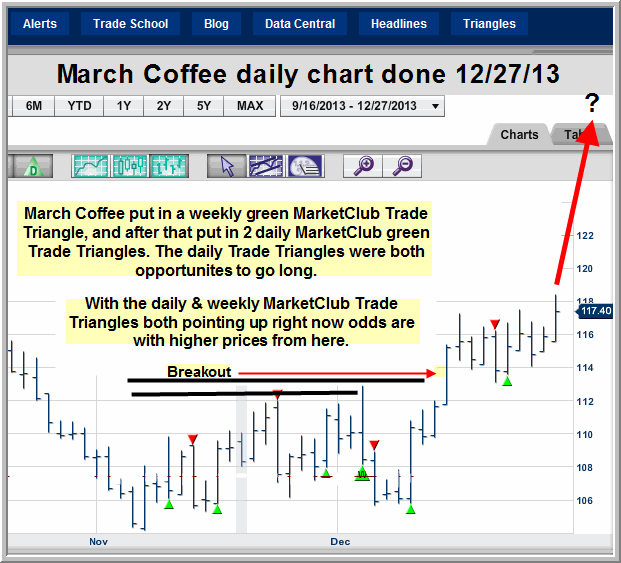
Chart to Watch - Coffee


We've asked our friend Jim Robinson of profittrading.com to provide his expert analysis of charts to our readers. Each week he'll be analyzing a different chart using the Trade Triangles and his experience.


Today he is going to take a look at the technical picture of March Coffee (NYBOT:KC.H14.E ).


With futures you use the weekly MarketClub Trade Triangles to tell trend and the daily MarketClub Trade Triangles for timing the entry and exits to the trade.


Coffee made a base, has made a breakout of the base to the upside and a test of the base, which means a bottom is probably in for Coffee.


When ever the weekly MarketClub Trade Triangle is green, then you can use daily green Trade Triangles as entry signals to go long in the market.


Since the weekly Trade Triangle went green there have been 2 daily green Trade Triangle buying opportunities.


With the daily and weekly Trade Triangles both green, odds are with the upside for Coffee making this a great Chart to Watch right now !


Thanks,

Jim Robinson

Profit Trading.com


news

Hollywood struggles against new film meccas


Director James Cameron attends a press conference on Monday, Dec. 16, 2013, in Wellington, New Zealand, to announce that he will shoot three sequels to his 2009 sci-fi blockbuster movie “Avatar” in New Zealand. “Avatar,” which was shot and made in New Zealand, won three Academy Awards and is the highest-grossing film in history, with an international box office take of nearly $2.8 billion. AP/Nick Perry


LOS ANGELES – In the old days, filmmakers flocked to Hollywood for its abundant sunshine, beautiful people and sandy beaches. But today a new filmmaking diaspora is spreading across the globe to places like Vancouver, London and Wellington, New Zealand.


Fueled by politicians doling out generous tax breaks, filmmaking talent is migrating to where the money is. The result is an incentives arms race that pits California against governments around the world and allows powerful studios —with hundreds of millions of dollars at their disposal— to cherry-pick the best deals.


The most recent iteration of the phenomenon came earlier this month when James Cameron announced plans to shoot and produce the next three “Avatar” sequels largely in New Zealand.


What Cameron gets out of the deal is a 25 percent rebate on production costs, as long as his company spends at least $413 million on the three films.


“There’s no place in the world that we could make these sequels more cost effectively,” says producer Jon Landau. It is neither the archipelago’s volcanoes nor its glaciers that are attractive, because the “Avatar” movies will be shot indoors. Sure, Peter Jackson’s award-winning special effects infrastructure is there, but the deciding factor was the money. “We looked at other places,” says Landau. But in the end, “it was this rebate.”


In exchange, the local economy will benefit hugely, Landau says, comparing the ripple effect to the boost that comes from new home construction. “We’re doing lumber, we’re catering for hundreds of people a day. We’re housing people in hotels. We’re going to a stationery store and tripling their business in a year.”


The deal was “the best Christmas present we could have possibly hoped for,” says Alex Lee, an Auckland, New Zealand-based entertainment lawyer. The news is especially welcome because the local screen industry is facing a potential drought: The Starz pay TV series “Spartacus” finished this year and Peter Jackson’s “The Hobbit” trilogy is set to wrap next year. Thanks to the “Avatar” sequels, the 1,100 workers at Weta Digital Ltd., the ground-breaking digital effects house Jackson co-founded in 1993, can keep plugging away through 2018.


“It would have been a real shame if we had lost any of that talent and they had to move to follow the films,” says Wellington Mayor Celia Wade-Brown.


Driving the trend are powerful global forces squeezing the entertainment industry. Falling DVD sales are putting pressure on movie-making budgets, while the demand for ever-more-amazing special effects grows. The spread of technology and skills around the world is creating a huge number of special effects suppliers — some using cheaper labor than can be found in Hollywood.


Government largesse has helped create mini-moguldoms in Vancouver, Montreal, London, New York and Wellington, all of which are aggressively one-upping each other to become the next new hotbed of activity. As the work spreads, branch offices of visual effects companies have opened up in new locations. Even though digital work is borderless, workers must live and be paid locally to generate the income taxes and spending that governments seek.


The tax incentives race is destined to accelerate next year. State incentives in California — home to “Star Wars” pioneer Industrial Light & Magic — are too small to accommodate big-budget movies. Democratic Assembly member Raul Bocanegra is preparing a bill to expand their scope, but it could take months to get through committees, says his chief of staff, Ben Golombek.


And the U.S. federal incentive, an arguably difficult-to-use tax deduction of up to $20 million per film or TV episode, is set to expire at the end of 2013.


“Once our federal incentive ends in two weeks, you’re going to have a lot of people who are going to go elsewhere,” says Hal “Corky” Kessler, a tax incentives lawyer with Chicago-based Deutsch, Levy & Engel.


Industry business leaders say they’re simply following the money.


“This is no different than any other multinational business,” says Sir William Sargent, co-founder and CEO of Framestore, a London-based special effects business that worked on likely Oscar-contender, “Gravity,” and has offices in Montreal, New York and Los Angeles. “We’re just going to where our customers are.”


Even if the U.S. moves to counteract growing incentives overseas, the efforts won’t prevent another jurisdiction from offering a bigger break.


Joseph Chianese, executive vice president at consulting company EP Financial Solutions, says the competition to offer attractive incentives is intense. More than 30 countries and 44 U.S. states now offer tax breaks to filmmakers.


The mix “changes daily, but it’s not going away,” Chianese says. “We have now trained a generation of filmmakers and TV makers that production doesn’t have to happen here anymore.”


seo tools