Wednesday, July 31, 2013

Asian shares broadly lower, Fed meeting in focus


A man walks by an electronic stock board of a securities firm in Tokyo, Monday, July 29, 2013. Asian markets mostly fell on Wednesday in the final hours before investors learn more about the US Federal Reserve’s plans for its massive stimulus program. AP PHOTO/KOJI SASAHARA


HONG KONG—Asian markets mostly fell on Wednesday in the final hours before investors learn more about the US Federal Reserve’s plans for its massive stimulus program.


Traders have remained cautious ahead of the central bank meeting, although most economists are confident the Fed will indicate that the $85-billion-a-month bond-buying will stay in place for the time being.


Tokyo closed down 1.45 percent on profit-taking after the previous day’s gains. The Nikkei gave up 201.50 points to 13,668.32.


Seoul lost 0.16 percent, or 3.02 points, to end at 1,914.03. Sydney closed flat, edging up 4.8 points to 5,052.


Shanghai rose 0.19 percent, or 3.74 points, to 1,993.80, while Hong Kong fell 0.32 percent, or 70.30 points, to 21,883.66.


Concerns about the future of the so-called quantitative easing programme have led to fluctuations in global markets in recent months.


But Fed chief Ben Bernanke has reiterated the bank’s intention only to wind down the scheme when the US economy can stand on its own two feet.


The greenback fetched 97.85 yen, compared with 98.02 yen in New York Tuesday.


The euro fetched $1.3261 and 129.75 yen, against $1.3264 and 130.02 yen.


The single currency has enjoyed some measure of support over the past few weeks—it hit a one-month high of $1.3302 at one point in New York Tuesday—amid signs the eurozone economies are finally picking up and could even move out of recession.


Asian equities were given a soft lead from Wall Street Tuesday, where the Dow and S&P 500 were flat and the Nasdaq edged up 0.48 percent.


Weaker-than-forecast US consumer sentiment figures offset an upbeat report on home prices.


On oil markets New York’s main contract, West Texas Intermediate for delivery in September, was up 55 cents at $103.63 a barrel. Brent North Sea crude for September fell 17 cents to $106.74.


Gold cost $1,332.27 per ounce at 1040 GMT, compared with $1,323.50 late Tuesday.


In other markets:


– Mumbai ended flat, down 0.01 percent, or 2.64 points, to 19,345.70.


India’s mobile phone firm Reliance Communications rose 10.14 percent to 139.6 rupees while private Essar Oil fell 9.96 percent to 51.55 rupees.


– Bangkok lost 0.86 percent, or 12.30 points, to 1,423.14.


Oil firm PTT Global Chemical dropped 5.71 percent to 66.00 baht, while Thai Airways International jumped 5.58 percent to 22.70 baht.


– Singapore closed down 0.72 percent, or 23.52 points, at 3,221.93 Property developer Capitaland was down 0.62 percent to Sg$3.23 and DBS Bank decreased 0.54 percent at Sg$16.70.


– Jakarta closed higher 0.04 percent, or 1.89 points, at 4,610.38.


Car maker Astra International rose 0.78 percent to 6,500 rupiah, while telecommunication and network provider Telekomunikasi Indonesia gained 1.28 percent to 11,900 rupiah.


– Kuala Lumpur slumped 1.27 percent, or 22.46 points, to close at 1,772.62.


Budget airline AirAsia lost 0.9 percent to 3.16 ringgit, while financial firm CIMB Group Holdings fell 3.4 percent to 7.87. DiGi.com gained 0.7 percent to 4.65 ringgit.


– Taipei slipped 0.68 percent, or 55.61 points, to 8,107.94.


Taiwan Semiconductor Manufacturing Co. was 0.49 percent higher at Tw$102.5, but smartphone maker HTC was 7.0-percent limit-down after it warned that it may swing to a loss in the third quarter.


– Manila closed 1.32 percent lower, shedding 88.88 points to 6,639.12.


Alliance Global Group fell to 3.14 percent to 26.25 pesos and Philippine Long Distance Telephone lost 0.98 percent to 3,020 pesos.


– Wellington fell 0.28 percent, or 12.60 points, to 4,537.99.


Mainfreight was down 2.45 percent at NZ$10.75, Fletcher Building shed 0.37 percent to NZ$8.13 and Air New Zealand was steady on NZ$1.45.—Danny McCord


Follow Us


Recent Stories:


Complete stories on our Digital Edition newsstand for tablets, netbooks and mobile phones; 14-issue free trial. About to step out? Get breaking alerts on your mobile.phone. Text ON INQ BREAKING to 4467, for Globe, Smart and Sun subscribers in the Philippines.

Short URL: http://business.inquirer.net/?p=135843


Tags: Asia , Finance , Forex , gold price , oil prices , stocks


Factual errors? Contact the Philippine Daily Inquirer's day desk. Believe this article violates journalistic ethics? Contact the Inquirer's Reader's Advocate. Or write The Readers' Advocate:


seo tools

Apple – The Cheapest Growth Stock in the Market


Apple (NASDAQ:AAPL) is no longer the high flying growth giant the markets once loved. In the ten-year period starting in 2003 the stock saw gains of as high as 5,000%. The run up was nothing short of Wall Street magic.


Those days are over…but a new opportunity has emerged.


You see there are two classes of stocks. The first is comprised of optimistic growth stocks – Google, Tesla, Amazon and the like. These stocks trade at incredibly high earnings multiples because investors are factoring in expected growth. Simply put, they are anticipating the company to grow its earnings at a much faster rate than the overall market and therefore are paying much more for the cash these companies are generating today.


This is known as speculation. I prefer to think of it as gambling, but that's another topic.


The second class of stocks is made up of dominant, blue chip companies. These are market staples that everyone is familiar with and have consistent track records of proven earnings. More active investors tend to think of these stocks as boring, and in their defense, they usually are. For the most part they follow the trend of the overall market and don’t experience the same extreme price fluctuations found with speculative growth stocks.


Apple has now become the latter. It joins the ranks of 3M, General Electric, Home Depot and the majority of the Dow Jones 30.


However, lying deep below its presently boring, predictable exterior lies something you cannot find in other "boring" stocks – raw, uncapped, game-changing potential that could and likely will be unleashed in the near future.


Everyone knows that Apple was a game changer. No one can argue that.


They completely revolutionized the cell phone market and left competitors scrambling to produce a rival product. They changed the way we buy, share and listen to music. They streamlined media through their Apple TV and iTunes store in ways never imagined just ten years ago. They introduced the world to tablet PCs, cleaner operating systems, and a vertically integrated architecture that has raised the bar for every technology company in the world.


All of these things they accomplished in under a decade.


The question everyone’s asking today is, "What are they going to do next?"


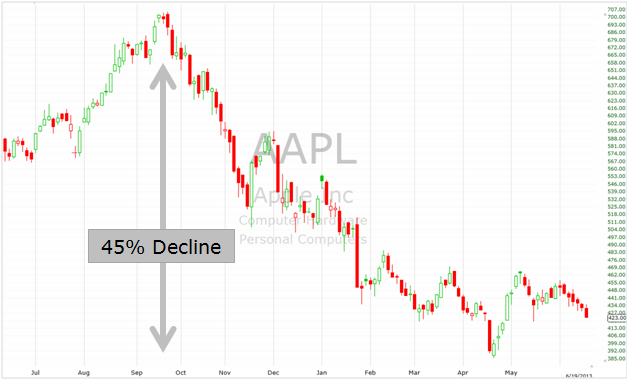
And no one has the answer. Investors became so accustomed to explosive earnings growth and exceeded forecasts that as soon as Apple was inevitably forced to slow down and take a breath, the stock dropped like a rock – 45% in just over 7 months.


(Chart courtesy of freestockcharts.com)


As of July 2013 the stock was trading at about $450 per share. This is where the opportunity arises for us.


Please note that I am not speculating on Apple’s next product or what its earnings will be for the upcoming quarter. The analysis I am about to share with you is made under no presumptions of future projections or product offerings. In fact…


Let’s assume that Apple never grows again.


Pretend that they will never again change the face of consumer technology (even though I think they will) and sit content earning roughly the same numbers they have been reporting for the last twelve to eighteen months.


Keep in mind that Apple only holds a 10% market share in the mobile phone market – far lower than Nokia’s 16.6% and Samsung’s 29.0%. They do not sit on the 1st place pedestal with nowhere to go but down.


Let’s see what this company is worth and how it stacks up against the rest of its "boring" slow-growth friends.


For the trailing twelve months leading into Q2 2013, Apple was producing a 28.00% return on equity. As of July 2013 the stock was trading at just 2.40 times revenues with a P/E ratio of just 10.14 (the price to earnings ratio is simply a multiple of how many times net income the stock is trading for).


Free cash flow, the truest measure of a stock’s ability to generate cash and growth for shareholders, also comes in at a low multiple of just 9.09.


This means that if you owned 100% of Apple, Inc., after all revenue is counted and all expenses are paid, you would have received an 11% return on your money – not bad for a boring stock that everyone has written off.


But that doesn’t even factor in the cash hoard held by the company.


Of the company’s $412 billion market cap (total number of shares times price per share), the company holds $116 billion in cash. This means that over 28% of the share price is protected by cold hard cash. Factor that in to the previous free cash flow yield and you are looking at a 15.49% return.

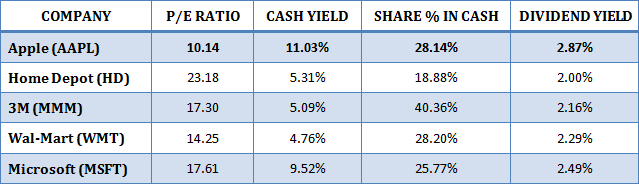
To put these numbers into perspective, let’s compare them with a few other staple companies:


As you can see, Apple has a price to earnings ratio well below the market average (18.83 for the S&P 500 as of June 2013), a high cash yield, more than respectable cash reserves, and a competitive dividend.


But how likely is it that Home Depot, 3M, Wal-Mart or even Microsoft will develop new products that not only shape the lives of consumers, but also unlock huge new sources of revenue?


The fact is that even though Apple is priced at a level below similar large cap stocks, its future prospects are miles ahead of the other companies shown.


We don't know what that next great product is going to be. None of us could have imagined iPads, iPhones, Apple TV’s and iPods in the hands of so many less than a decade ago. Apple is an innovator, and even though Steve Jobs has since passed, this company will continue to operate on the cutting edge and bring new products to market that competitors will be forced to mimic as they have been since 2003.


But even if they don’t...


You are still getting a wonderful company for lower multiples than you can buy other large blue chips.


And guess what companies do when they no longer feel like they can grow? They pay out excess cash in the form of shareholder dividends. Apple began paying dividends for the first time in August 2012. For the last 12 months, they have paid out just 19% of earnings for the same time frame. If they start distributing their $100 billion+ cash vault, we could see some huge one-time special dividends (a common practice for cash-rich companies that run out of growth channels). I expect Apple to develop into more of a blue-chip stock, in which case they are likely to increase this payout ratio dramatically.


To give you an example, Johnson & Johnson pays out 66% of its earnings in the form of dividends. 3M and Kraft Foods each pay out approximately 38%. Similar levels for Apple would equate to a 6-10% dividend at today’s prices.


All of this adds up to one thing – Apple is much safer than investors think.


Most people would argue that Wal-Mart is about as safe of a stock as you can buy. But is it really?


As of July 2013, it trades at almost a 50% greater earnings multiple and has a true earnings yield of less than half that of Apple. It holds less cash reserves and offers a lower dividend. Their earnings are slightly more consistent, but their growth potential is nowhere near that of the iGiant. You are simply paying more money for every dollar of this company’s earnings, therefore reducing your yield and potential capital appreciation.


In regard to the consistency of Apple’s earnings, I think the market will be surprised at how steady they will be going forward. Even without much growth, this company has entrenched itself with consumers and developed one of the strongest brand loyalties in America. Go ahead…try and force a Mac user to switch to a PC.


The real brilliance in their product development is the vertically integrated infrastructure in which they have built their brand.


Everything is connected, synced and integrated through a near flawless multi-device operating system and e-commerce platform. Your phone automatically shares pictures, videos, purchased media, contacts and even passwords with all of your other Mac devices. Media purchases in the form of music, television shows, movies and apps can be purchased with a single click from your home computer, tablet, iPhone or iPod. This media is then digitally stored on Apple’s servers, allowing you to access it from any device at any time.


Lose your iPhone? Enter your Apple ID and everything magically comes back to life. Your contacts, emails, music, videos, pictures and personal files are effortlessly restored to your new device. This high-level integration creates loyalty from consumers, whether they like it or now.


You see, over time consumers build up a digital library of purchased media and personal files. To leave Apple means to leave all of that behind. In true Apple fashion, nothing is compatible with their competitors’ operating systems. Your music albums, video purchases, stored passwords, contacts and other data are all lost by switching to an Android or Windows platform. It is the modern day equivalent of losing your purse or wallet and having to replace your driver’s license, credit cards, personal photos and anything else you kept safe.


Cell contracts will end, hardware will become outdated, your kid will step on your iPad, and people will continue to replace their electronics with Apple’s newest versions.


The biggest mistake Wall Street is making is not recognizing the customer loyalty and future earnings consistency of this company.


If you are looking to add long-term holdings to your portfolio – take a look at Apple (NASDAQ:AAPL). This is a rare chance to buy an industry leader at below industry prices.


Invest Well,

Ross Givens

President, Blue Tick Research


To sign up for free nightly educational videos, visit www.BlueTickResearch.com


Ross Givens is a security analyst with a great devotion to the strategy of value investing. He uses company fundamentals to calculate share values based on net working capital and future earnings projections and then invests only when stocks are trading at a deep discount to that value.


As a former investment advisor, registered representative, securities broker and AP, he worked for major wire houses, wealth management firms, day trading companies, investment educators and managed commodity programs. With years of experience and an inside perspective from some of the biggest names in the investment world, Ross brings a unique approach to the equity markets.


Disclosure: INO.com is not affiliated with Blue Tick Research and doesn't hold any shares of Apple, Inc. (AAPL)


news

Are Gold Equities on the Cusp of an Upswing?


The Gold Report: Ron, the Federal Reserve has decided to continue quantitative easing (QE) for the foreseeable future. Gold has risen steadily since that news. Is that what you predicted the Fed would do?


Ron Struthers: It is not that hard to predict the Fed's behavior when you understand what it's trying to do and how it's trying to do it. I do not take what they say literally, except within the context of its goals. The Fed is trying to instill confidence in the economy because of massive U.S. debt and its future debt appetite. The economy needs to improve for there to be higher tax receipts. We need foreign investment to finance the debt. If the Fed can convince Americans and those abroad that its bonds are the safest/most attractive, its stock market will have the best returns and that debt machine keeps running.


But the truth is that the economy is very weak. Employment is weak. Foreign investment has been fleeing. The Fed has to purchase $85 billion of debt a month because nobody else will. The Fed can't do this forever, and it knows it. It has to talk as if the economy is improving so the Fed debt purchases can end in the near future.


If you dig into what's really going on in the economy and markets, you'll find the underlying weakness that guarantees that QE will be here for a long time, as least as long as the markets themselves will allow it or are tricked into allowing it.


TGR: Why are Americans so complicit in this?


RS: Too many take for gospel what they read and see in the mainstream media. There's a pretty good media propaganda machine out there for the government.


TGR: Do you think the Fed should exist?


RS: I've never gotten into whether it should exist or not. Let's just deal with what we have. I do think that its hand has gotten way too heavy in the markets.


TGR: Now that QE is going to continue for a while, what is the trade in gold and where are the catalysts for an even higher gold price?


RS: We've been waiting for a bottom. We've seen that now, and it's time to buy. There are still a lot of the same catalysts, such as many central banks are switching out of the dollar, yen, euros and diversifying to gold. Continued QE just means a continuation of that diversification.


Asia still has record demand for physical gold. Since the Bank of Japan announced the most aggressive QE program thus far, Japanese funds and the pension funds have started to buy gold-related investments; this is a first and has only just begun.


Since the price drop, we've seen a lot of mine closures and curtailment, which will only result in less supply in an already tight physical market.


However, the main catalyst is the reason gold was driven down in the first place. It has run its course and that was fulfilling the goal of the bullion banks.


TGR: Which is?


RS: The bullion banks run a fractional reserve gold system just like the bank system, meaning they only have one ounce of gold for every 50, maybe even 100 or more, sold. We don't know the exact numbers, but it's something along that line. That system came under stress with the lack of confidence and was driven, in part, by major countries like Germany repatriating gold. The fact that it is going to take seven years for Germany to get its gold tells you something about this fractional reserve system.


The bullion banks were, and are still, seeing a run on their physical reserves as inventories are falling, and so are the COMEX inventories. But at the same time, the bullion banks had this huge short position in gold and silver. We've seen a behind-the-scenes rescue of these bullion banks, at least for now.


TGR: In a recent edition of Struthers' Resource Stock Report, you said that many of these bullion banks are actually long gold now.


RS: We don't know exactly what any one bullion bank does, but we get some very good clues from the weekly COMEX Position of Traders report. The section of the report called "The Commercial," which includes the bullion banks, shows the reported short and long positions. We have seen a large net short position there for many years. But with this big drop in gold prices, that short position has been taken down to near nothing. At the same time, we've seen the category where we find the speculators and hedge funds at record net short levels. The short position has been moved from the strong hands to weaker ones. I see this as another bullish signal.


TGR: You also see some weakness in the recent jobs data. Tell us more about that.


RS: We hear the U.S. headline job number, talk about all these jobs we're creating and how good it is. The devil is in the details, they say. The last report actually saw 220,000 full-time jobs disappear. All the gains were part-time jobs. Right now, the second largest employer in the U.S. is a temp agency, and some 10% of the workforce is temporary because companies can't afford full-time workers or have little confidence for that commitment. That's a big sign we never have seen a real recovery.


Only 47% of Americans have full-time jobs. Some people have two part-time jobs now. The same person working in two places counts as two jobs, but it's just one person. The previous month's report sounded good, too. It reported more new jobs, but the hours of work dropped. I just see these employment numbers as part of the virtual economy, not the real one.


TGR: Do you believe that gold has already bounced off of its 2013 bottom?


RS: I think so. The $1,1001,200/ounce ($1,1001,200/oz) barrier was a good support level for gold, and we bounced out of that. I think we've seen the bottom. I thought we could possibly see a retest of that support, but because gold has done so strongly already, I think a retest of that becomes less likely now.


TGR: A group of Canadian financial companies led by the Royal Bank are attempting to launch a stock exchange to rival the Toronto Stock Exchange (TSX). The carrot at the end of the stick seems to be the elimination of predatory trading by computer-based programs. Does this idea have any traction?


RS: It has traction given that a large bank is behind it. I talk to investors and traders almost daily, and they've been fed up with computer trading for quite a while. Very simply, it's just totally unfair. Orders are not real and come and go quicker than humans can act.


"If you dig into what's really going on in the economy and markets, you'll find the underlying weakness that guarantees QE will be here for a long time."


Maybe you see a bid for 1,000 shares on some stock. You try to sell, but the computer sees your order coming, maybe fills 200 and then reduces the bid and you remain unfilled. You can take lower and lower prices if you want.


The same with buying. More shares can show up less than a second after you buy, so you don't know how many shares there are on offer, who is selling, how much or whether something is wrong because there's so much selling. Sometimes you don't even see your trades. You'll see, say, a bid at $0.35 and an offer at $0.40 on some particular stock. Maybe you put an order in to buy at $0.40, and you see no trade go through, but your brokerage account shows filled. The next day you find it settled at $0.38 because there was an offer there from a different trading platform.


For the most part, these different platforms are computer-driven participants. It has induced a huge lack of confidence and unfairness in the markets. It created two playing fields: the rich, big players and the small investor on the bad end of the stick.


What is also unfair is that these computer trades are given a rebate or less fees on their commission, so they're even given an advantage on commissions over regular investors. They say it's in the name of supply and liquidity, but it's just another unfair practice.


TGR: Wouldn't the Toronto Exchange argue that it's not a profitable enterprise without computer trading?


RS: I'm sure it is going to put up any kind of blocks that it can.


TGR: This sounds like an almost ideal bourse for junior mining stocks. What incentive would the new exchange offer for companies to come over?


RS: I don't think they will have to actually come over; TSX-listed companies could trade there. It would operate like another trading platform. The TSX has already lost about 40% of the volume to other trading platforms out there now like Alpha. This bourse is still in a discovery period right now. It's still exploring all the options for how to work this. It has an outline, but the goal is to go with a formal application around year-end. If it makes an official application by year-end, we could see this in 2014.


One thing I found quite interesting is it would take private company shares. A brokerage could take in the shares and create a market, creating some liquidity for private companies.


TGR: Why would private companies list? They have no desire to make their financials public.


RS: They actually don't list but it creates some liquidity for their current shareholders. At the same time, they don't have the regulatory burden as a public startup company. They can put more money into their companies and bring them to a stronger level before going public.


TGR: Without the transparency, investors could lose a lot of money.


RS: On the private sector side, it would only be qualified/accredited investors under the current TSX guidelines that could own and trade in these shares.


TGR: Is there any word from the federal government on whether it would back a new exchange such as this?


RS: I haven't heard much yet. This just came out at the end of June. We're going to hear lots about it between now and year-end, but it's just in its infancy now.


TGR: You follow a number of small-cap, mid-cap and large-cap gold and silver equities. Please outline your thesis for the small-cap silver and gold equities.


"I keep a long-term outlook. We have these ups and downs. This has been the worst, but this could be the fourth good correction."


RS: We use stop losses, and we got stopped out of almost all of our gold stock positions quite a while ago. I've never seen anything like it, but the market is what it is. Seeing a bottom, we first started going in and buying back the larger and midtier producers and some of the junior producers. Then later on, we'll start adding more of the exploration plays as long as the market keeps advancing.


TGR: What are some junior companies you're writing about in Resource Stock Report?


RS: Claude Resources Inc. (CRJ:TSX; CGR:NYSE.MKT) is one I recently bought back. I couldn't believe how far that got beat downto about $0.20/share. The main reason was that its costs are high at around $1,245/oz. However, it just completed a shaft extension at its Seabee mine that will reduce costs. It already has higher costs at the first of year because it has to restock its mine utilizing winter ice roads. The restocking program went well this year, with lower costs than last year and lower costs in many consumables. Given that and the recovery in the gold price, we could see quite a turnaround in that stock.


TGR: Claude posted a loss of $0.01/share in Q1/13. Is it on track to turn that around?


RS: The extra leverage you get is another advantage when you buy companies with costs very close to the current price. A $100/oz increase in gold would turn it from losses to profits. Just that $100/oz can make quite a difference, and you can see that leverage reflected in the improvement in the stock price.


TGR: Where is the growth going to come from, Ron?


RS: It is going to get some growth from the Seabee mine, but the big growth is going to come from its Madsen project in Red Lake, Ontario. It actually has more gold resources there than its mine. It has been advancing that project. Bringing that into production down the road is going to provide quite substantial growth.


TGR: What is another junior story?


RS: Richmont Mines Inc. (RIC:TSX; RIC:NYSE.MKT) has 2 million ounces (2 Moz) in reserves and resources and is producing about 65,000 ounces (65 Koz) a year. Its cash cost was high last quarter, at $1,300/oz, but that should improve. It had lower grades mined the previous quarter, which is going to improve in H2/13. It is also putting a new W Zone at the mine into production. It did a successful bulk sample test, at grades of 5.3 grams per tonne with 97.4% recovery.


The company has always been managed very prudently. It only has 40 million (40M) shares out, a strong cash position of $43M and less than $1M in debt. It has a $50M loan facility available as well, so it is in a strong position. The market is valuing its mines and ounces at just $20M right now. If you look at 2 Moz reserves and resources, they're valued at $10/ozand that's at a producing mine. I just find that ridiculously cheap, but the market is ridiculous now.


TGR: Do you think Richmont would use its cash position to take advantage of some other players that are not as cash rich?


RS: I don't think so. The management's track record is to more or less invest internally. It is more apt to improve the current mines and to acquire and advance some other properties. It could take advantage of acquiring properties off some of these other companies instead of taking out a whole company.


TGR: You mentioned its cost of production was a touch high. What is it doing to remedy that?


RS: The high costs are a short-term issue. It will get by this as the year progresses and fall more in line with normal grades that are a bit higher. This additional zone is a higher grade zone that will help with that. It's also paring costs wherever it can, cutting corners here and there like all the gold miners now.


TGR: What other stories are you following?


RS: On the senior side, I added Newmont Mining Corp. (NEM:NYSE) recently.


TGR: Because of the yield?


RS: Newmont gives good leverage as a dividend play because its dividend is based on the gold price. The dividend was $1.40/year, which is yielding about 5%, but that's probably going to drop to about $0.80/year because of the current gold price.


The dividend goes by the average of the previous quarter. The dividend increase is for every $100/oz increase in gold, $0.20/year. Once gold hits $1,700/oz, then it increases $0.30/year for every $100/oz increase. At $2,000/oz gold, it jumps $0.40/year for every $100/oz increase. That's some pretty good leverage there. If we get to $2,000/oz gold, the dividend would be $2.70 each year per share.


For now, I'm just betting gold recovers and Newmont is at least paying $1.40/share. That would give us a 5% yield at the current stock price.


TGR: Is yield the only reason why Newmont hasn't been beaten up like Barrick Gold Corp. (ABX:TSX; ABX:NYSE)?


RS: They've all been beaten up pretty good. Maybe Newmont was spared a little because of the yield. Most of the majors are paying some kind of dividend now, but Newmont is among the highest.


TGR: Are there some distressed names that offer compelling value in this market?


RS: They're all distressed at this point!


I've been looking at another good company that is quite interesting in South Africa. I haven't picked much up there for a long time. Gold Fields Ltd. (GFI:NYSE) spun a company out of its holdings this year to create Sibanye Gold Ltd. (SBGL:NYSE). It came out trading around $7/share in February, just in time for the market to get hammered, and it dropped all the way down to a few bucks.


It is actually going to be the third largest producer in Africa behind Gold Fields and AngloGold Ashanti Ltd. (AU:NYSE; ANG:JSE; AGG:ASX; AGD:LSE). The trailing price-earnings ratio is just 2x earnings. It had a very positive Q1/13 with $170M profit and $66M free cash flow. Falling gold prices would naturally have an effect, but its impact has been overdone on the share price. Sibanye has two producing mines and offers good value down at these prices.


TGR: Why did Gold Fields decide to spin it out?


RS: It wanted to split its mining into two types. It spun out narrow-grade, underground mining that's labor intensive. Its other projects are more open-pittable, bulk scenarios with more machinery-type mines. It felt it was trying to manage two different types of mines. Now there is better concentration with a split along synergies.


TGR: Could you give us another small-cap name?


RS: Argonaut Gold Inc. (AR:TSX) has not been beaten down nearly as much because its costs are quite low at around $600/oz. The company has two producing mines and produced 93 Koz last year. It is projected to increase to 120140 Koz this year. Argonaut has two advanced projects under economic assessment, two more mines that could come onstream down the road. It should be able to fund all this internally because it is sitting on $168M in cash and has no debt. Argonaut could be a stock that could continue to outperform in the market going ahead. It's quite a good growth story.


TGR: How are you staying positive throughout what's happening in the junior mining sector?


RS: I keep a long-term outlook. We have these ups and downs. This has been the worst, but this could be the fourth good correction. Each time, these corrections get a little bigger and a little longer, but they're from bigger and higher prices. The next move will be a bigger and longer upmove. That's the carrot for belief in what's yet to come. Being that these stocks are so depressed, it's the best buying opportunity that I've ever seen, even better than in 2000 at the bottom.


TGR: Are you buying?


RS: Yes. I like the long-term call options on some of these majors, too. Because the market is so beaten up, the call premiums have gone to nothing. You can buy these call options that are out a year-and-a-half for $1 or $2 and control a $510 stock. There's a lot of leverage there.


TGR: Thank you for your insights.


For Ron Struthers' investing ideas on graphite, click here.


Ron Struthers founded Struthers' Resource Stock Report almost 20 years ago. The report covers senior and junior companies with ample trading liquidity. Since 2000, $1,000 invested in Struthers' Model Portfolio ended 2012 at $9,251. Struthers' Newsletter Stocks went from $1,000 to $20,934. Struthers' Millennium Index, which started in 2003, began at $1,000 and was worth $4,133 at the end of 2012.


Want to read more Gold Report interviews like this? Sign up for our free e-newsletter, and you'll learn when new articles have been published. To see a list of recent interviews with industry analysts and commentators, visit our Streetwise Interviews page.


DISCLOSURE:


1) Brian Sylvester conducted this interview for The Gold Report and provides services to The Gold Report as an independent contractor. He or his family own shares of the following companies mentioned in this interview: None.


2) The following companies mentioned in the interview are sponsors of The Gold Report: Richmont Mines Inc. and Argonaut Gold Inc. Streetwise Reports does not accept stock in exchange for its services or as sponsorship payment.


3) Ron Struthers: I or my family own shares of the following companies mentioned in this interview: Claude Resources Inc. and Richmont Mines Inc. I personally am or my family is paid by the following companies mentioned in this interview: None. My company has a financial relationship with the following companies mentioned in this interview: None. I was not paid by Streetwise Reports for participating in this interview. Comments and opinions expressed are my own comments and opinions. I had the opportunity to review the interview for accuracy as of the date of the interview and am responsible for the content of the interview.


4) Interviews are edited for clarity. Streetwise Reports does not make editorial comments or change experts' statements without their consent.


5) The interview does not constitute investment advice. Each reader is encouraged to consult with his or her individual financial professional and any action a reader takes as a result of information presented here is his or her own responsibility. By opening this page, each reader accepts and agrees to Streetwise Reports' terms of use and full legal disclaimer.


6) From time to time, Streetwise Reports LLC and its directors, officers, employees or members of their families, as well as persons interviewed for articles and interviews on the site, may have a long or short position in securities mentioned and may make purchases and/or sales of those securities in the open market or otherwise.


Article source: http://feedproxy.google.com/~r/theaureport/Ajgh/~3/S8TPicEFnZA/15478


news

Eurozone jobless down for first time in 2 years


Unemployed Greeks wait in a long line at a state labor office to collect benefit checks, in Athens, in this file photo. Greece and Spain have the highest unemployment rates in the eurozone, with both countries also mired in a youth unemployment crisis, according to figures released by Eurostat, the EU’s statistics office, Monday July 1, 2013, which reveals that unemployment across the 17 European Union countries that use the euro hit another all-time high in May 2013. AP


BRUSSELS — Further evidence emerged Wednesday that the eurozone economy is on the mend after struggling with a recession that’s seen unemployment edge toward the 20 million mark.


Figures from Eurostat, the EU’s statistics office, showed that the number of unemployed across the 17 European Union countries that use the euro fell by 24,000 in June to 19.27 million. That’s the first fall since April 2011 and adds to the weight of recent evidence that suggests the recession in the eurozone has — or is about to — come to an end.


The eurozone economy has been shrinking since the last quarter of 2011 as a raging debt crisis prompted many countries to pursue tough austerity policies that weighed on economic activity and confidence.


However, many analysts think figures next month will show the region may have eked out a modest growth during the second quarter, thanks mainly to a rebound in Germany, Europe’s biggest economy.


On top of that, other countries’ output — even for those at the forefront of Europe’s debt crisis — do not appear to be contracting on such a large scale as earlier on in the year. Figures this week showed that the Spanish recession nearly ended in the second quarter while there are hopes that even Greece may start growing again at the end of this year following a recession that’s wiped out around a fifth of the country’s output.


One of the most damaging effects of the eurozone’s return to recession has been an inexorable rise in unemployment particularly of the young. Over the past year, unemployment across the region has increased by 1.13 million.


Wednesday’s figures are only one month but they do provide some hope that there is now light at the end of the tunnel. In Spain, for example, the number of unemployed fell to 5.96 million from the previous month’s 6 million and that pulled the jobless rate down to 26.3 percent from 26.4 percent.


Overall, the unemployment rate in the eurozone was also lower than expected — though at a record high. At 12.1 percent in June, it’s unchanged on the previous month following a downward revision to May’s original 12.2 percent estimate.


Separately, Eurostat reported that consumer price inflation in the eurozone was unchanged at 1.6 percent in the year to July, in line with expectations. Though inflation remains below the European Central Bank’s target of keeping annual price rises just below 2 percent, rate-setters are expected to keep the bank’s main interest rate unchanged at the record low of 0.5 percent following the conclusion of their monthly policy meeting on Thursday.


Follow Us


Recent Stories:


Complete stories on our Digital Edition newsstand for tablets, netbooks and mobile phones; 14-issue free trial. About to step out? Get breaking alerts on your mobile.phone. Text ON INQ BREAKING to 4467, for Globe, Smart and Sun subscribers in the Philippines.

Short URL: http://business.inquirer.net/?p=135835


Tags: economy , eurozone , Recession , unemployment , World economy


Factual errors? Contact the Philippine Daily Inquirer's day desk. Believe this article violates journalistic ethics? Contact the Inquirer's Reader's Advocate. Or write The Readers' Advocate:


seo tools

Airbus parent reports higher H1 profit


The June 21, 2013 file photo shows the new Airbus A350 jet liner flying above the Bourget airport during the 50th Paris Air Show at Le Bourget airport, north of Paris. Automaker Daimler AG is reporting a big jump in net profit in the second quarter thanks to gains from selling its stake in aerospace firm EADS. The company said Wednesday, July 24, 2013 that net profit rose to euro 4.58 billion (US$ 6.04 billion) from euro 1.56 billion in the same quarter a year before. AP


PARIS — European aerospace group EADS is to change its name to Airbus and shake up its corporate structure as part of push to give its civil aviation division more prominence.


As well as the name change next year, European Aeronautic Defense and Space Co. will reshuffle its space and military units into one division, the company said Wednesday. It also unveiled a 31 percent increase in first-half net profits on the same time last year to 759 million euros ($1 billion).


EADS says the changes will “enhance integration and cohesion” of the 13-year-old group formed from the French, German and Spanish aerospace companies.


In the first half, the Airbus unit took in 722 net orders in the first half, up from 230 a year earlier. The civil aircraft business still accounts for almost 70 percent of EADS’ group sales.


EADS had once sought to become less dependent on its civil aircraft business with a goal of growing its defense business, maker of the A400M European freighter, to around half of total revenue. Those plans were shelved with the global economic downturn and government belt-tightening.


Under its new organization, a new defense entity will be created dubbed Airbus Defense & Space, housing the existing military business along with satellite maker Astrium and drone and electronics business Cassidian.


The Eurocopter civil and military helicopter business remains separate in the new organization but is renamed Airbus Helicopters.


EADS chief executive Tom Enders called the changes “an evolution, not a revolution.”


“We affirm the predominance of commercial aeronautics in our group and we restructure and focus our defense and space activities to take costs out, increase profitability and improve our market position,” Enders said in the statement.


Airbus delivered 295 civilian planes in the first half, just less than the 306 record by arch-rival Boeing. At last month’s Paris Air Show, Airbus took in firm orders for 241 aircraft including 65 for its A350 widebody.


The A350 is still undergoing testing, but is expected to enter into service in the first half of next year. It made its first fly-by over Le Bourget air field during the air show last month. On Wednesday EADS said the program “is now entering the most critical phase” and that it “remains challenging.”


“Any schedule change could lead to an increasingly higher impact on provisions,” EADS said.


Follow Us


Recent Stories:


Complete stories on our Digital Edition newsstand for tablets, netbooks and mobile phones; 14-issue free trial. About to step out? Get breaking alerts on your mobile.phone. Text ON INQ BREAKING to 4467, for Globe, Smart and Sun subscribers in the Philippines.

Short URL: http://business.inquirer.net/?p=135825


Tags: Airbus , Bourget airport , Daimler AG , Le Bourget airport , Paris , Paris air show


Factual errors? Contact the Philippine Daily Inquirer's day desk. Believe this article violates journalistic ethics? Contact the Inquirer's Reader's Advocate. Or write The Readers' Advocate:


seo tools

Siemens appoints finance chief Kaeser as CEO


Former CFO turned CEO of Siemens AG Joe Kaeser. AP


BERLIN — Siemens AG has appointed longtime finance chief Joe Kaeser as its new chief executive, replacing Peter Loescher after a series of missed profit targets at the German industrial conglomerate.


Siemens said its supervisory board unanimously chose the 56-year-old Kaeser on Wednesday. It said a new chief financial officer will be appointed “in due course.”


The company says Loescher would leave the board “by mutual agreement.” The company had announced on Saturday night that the supervisory board would meet Wednesday to decide on his departure.


On Monday, in an apparent sign of concern over media reports of infighting, a spokesman for Chancellor Angela Merkel said the German leader considered it important for the company — a German industrial heavyweight — return to “calm waters.”


Follow Us


Recent Stories:


Complete stories on our Digital Edition newsstand for tablets, netbooks and mobile phones; 14-issue free trial. About to step out? Get breaking alerts on your mobile.phone. Text ON INQ BREAKING to 4467, for Globe, Smart and Sun subscribers in the Philippines.

Short URL: http://business.inquirer.net/?p=135807


Tags: Joe Kaeser , Peter Loescher , Siemens


Factual errors? Contact the Philippine Daily Inquirer's day desk. Believe this article violates journalistic ethics? Contact the Inquirer's Reader's Advocate. Or write The Readers' Advocate:


seo tools

Budweiser brewer earnings fall on taxes, financing


AMSTERDAM— Budweiser maker Anheuser-Busch InBev SA saw its second quarter earnings fall by nearly a quarter due to higher taxes and higher financing costs.


The world’s largest brewer said Wednesday that its net profit during the period was $1.50 billion (1.13 billion euros), or $0.93 per share. That was down from $1.94 billion, or $1.21 per share in the same period a year ago. The fall came despite a 1.9 percent increase in revenues to $10.6 billion, on a mix of higher prices and lower volumes.


The Leuven, Belgium-based company noted that the volume decline — 1.2 percent from a year ago —was less severe than in the first quarter, when its Brazilian operations performed poorly.


The sales figures were a bit of a surprise following lackluster earnings by rival SABMiller last week and AB InBev’s share price rose 5.3 percent to 71.32 euros in early trading on the Euronext exchange.


These were the first results to be published since InBev’s $20.1 billion acquisition of Corona brewer Grupo Modelo in June. Brands owned by InBev make up nearly 50 percent of the U.S. beer market, and regulators forced it to sell Modelo’s U.S. business to Constellation Brands Inc., including the rights to Corona there, in order to win approval for the deal.


Tuesday’s results were published on a pro-forma basis — as if it had owned Modelo in both years. It also stripped out the impact of a one-time $6.31 billion gain due from a revaluation of the value of shares it held in Modelo before the acquisition.


InBev said net debt at the end of the quarter was $43.1 billion, up from $30.1 billion at the end of 2012, mostly due to financing the Modelo buy. The company said it expects to pay down debt relative to operating profit by roughly a third by the end of 2014.


In the United States, volumes were down 2.8 percent but prices were 3.9 percent higher, as the company carried out a series of price hikes in the fourth quarter of 2012. Its single best-selling beer, Bud Light, lost ground, but other Bud Light-linked drinks such as “Bud Light Lime Straw-Ber-Rita” and “Bud Light Lime Lime-A-Rita” sold well.


Similarly, Budweiser itself lost a fractional amount of market share, largely offset by gains at Budweiser Black Crown.


In Brazil, the company’s second-largest market, sales volumes were down 0.4 percent, which InBev said was a “good improvement after a challenging first quarter.”


The company said positive factors in Brazil include slowing general price inflation, the success of its advertising programs, and a boost from the FIFA Confederations Cup soccer tournament in June.


“We expect pressure on consumer disposable income in Brazil to continue for the remainder of the year,” InBev said.


It did not mention a profit forecast in its outlook for 2013 as a whole but said it expected the trend of lower volumes and higher prices to continue. It raised its estimates for capital spending in 2013 to $3.9 billion from $3.7 billion, as it expands capacity in China, Brazil and Mexico.


Follow Us


Recent Stories:


Complete stories on our Digital Edition newsstand for tablets, netbooks and mobile phones; 14-issue free trial. About to step out? Get breaking alerts on your mobile.phone. Text ON INQ BREAKING to 4467, for Globe, Smart and Sun subscribers in the Philippines.

Short URL: http://business.inquirer.net/?p=135791


Tags: Anheuser-Busch InBev SA , beer , brewer , Budweiser


Factual errors? Contact the Philippine Daily Inquirer's day desk. Believe this article violates journalistic ethics? Contact the Inquirer's Reader's Advocate. Or write The Readers' Advocate:


seo tools