
Monday, December 29, 2014

Natural Gas Takes Its Turn At The Puke Bowl


Adam Feik - INO.com Contributor - Energies


Natural gas futures on Friday dropped below $3 for the first time since September 2012, on an intraday basis. December is now on track for the dubious distinction of producing natty’s largest one-month drop since 2008 – currently about a 26% month-to-date (MTD) decline – as producers continue churning out the commodity even while mild weather has resulted in below-normal consumption.


Crude oil, by comparison, has declined about 17% in December (MTD).


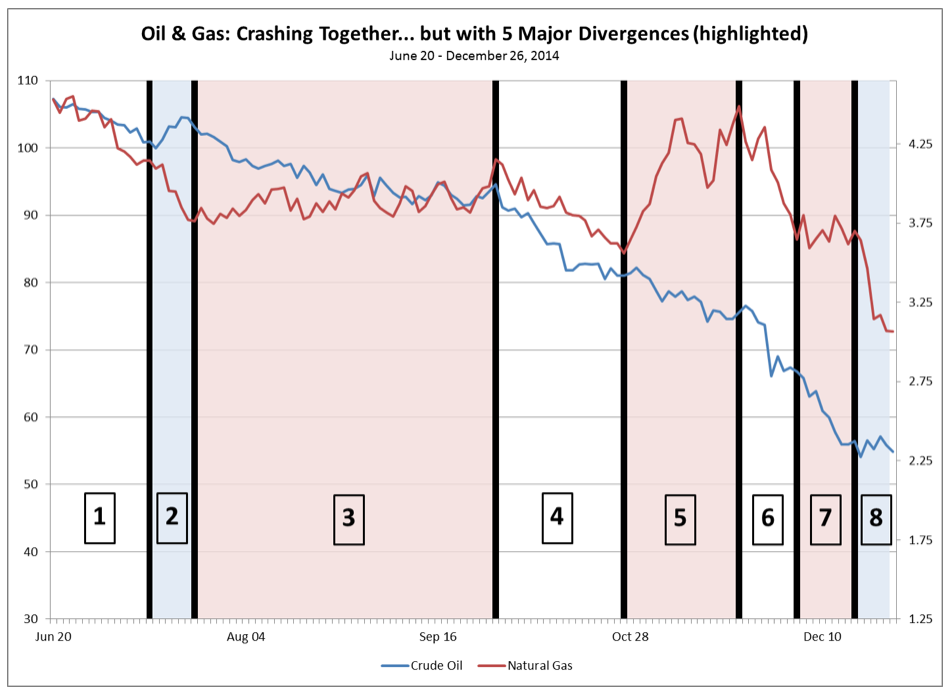
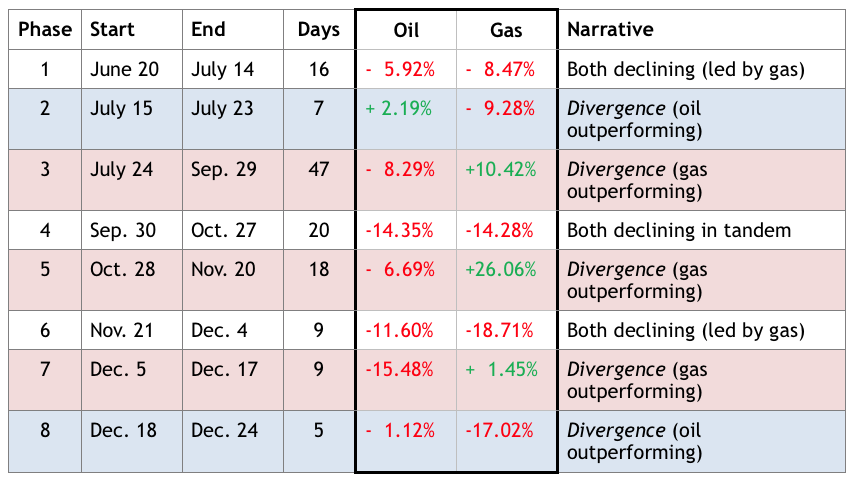
Natural gas and crude oil prices have taken turns out-dropping each other over the past 6 months. This simple graph (and accompanying chart) shows how oil and gas have crashed both together and separately for the last 6 months. What do I mean by that? Both have nosedived, but with 5 distinct periods of divergence (highlighted in blue when oil is outperforming, and highlighted in red when gas is outperforming). See for yourself:


In total:


  • Oil & gas have crashed “together” for 3 of the 8 periods, for a total of 45 trading days in which gas has generally declined more than oil.

  • Oil has “diverged” to the upside in 2 periods (highlighted in blue), for a total of 12 trading days.

  • Gas has “diverged” to the upside in 3 periods (highlighted in red), for a total of 74 trading days.


Actually, at its recent peak on Nov. 20th, natural gas prices were only a few pennies below their June 20th level; so effectively all of natty’s 2014 crash has occurred in just over 23 trading days since just before Thanksgiving.


What happened to natural gas from Oct. 28th through Nov. 20th, when it rose about 26%?


Remember the polar vortex, which returned to the US during that time? Investors wondered if the country might be in for another long, cold winter like the last one. But that idea – along with natural gas prices – hit a nice, warm wall of resistance around Nov. 20th. Since then, mild weather has allowed natural gas prices to basically freefall along with its crude cousin.


In trading on Friday, Dec. 26th, natural gas lost about 0.16%, and oil lost about 1.72%.


All told, oil and gas futures have both regurgitated 30-50% over the last 6 months, but they haven’t declined together very much of that time. Which somewhat makes sense. Aside from weather, both oil & gas are subject to many similar pressures – oversupply, the US shale boom, shrinking demand due to slow global growth, etc. (Oh… sorry for the “puke” references, by the way; my wife, kids, and I have been sick all week; ugh!).


Investors are starting to look for bottom-feeding opportunities. Many are trying to find a theme, such as energy-sector stocks that haven’t deserved the punishment they’ve have been dealt. I read a Kiplingers article that was published a few days ago, but used price quotes from Dec. 16th. Unfortunately, a lot has changed since then!


One of the article’s main premises was that certain companies who deal predominantly in natural gas should not have seen their share prices lose as much value as companies who deal mostly in oil. Oops! Natural gas prices have fallen more than 15% in just the few days that article was apparently awaiting publication.


Still, the article probably had some very valid points, in the long term. In fact, I added a couple of the article’s recommended stocks to my MarketClub watchlist, just to keep an eye on them and see when their price movement turns around. Whenever an uptrend begins, I don’t disagree with Kiplinger’s sources that these natural gas companies may represent opportunities to “buy low.” Of course, none of the 5 stocks are showing any strong technical signs right now. All have 2 or 3 red triangles and very weak MarketClub scores. I prefer to be patient before buying an investment, in order to allow the market to provide signals that demand is taking control. I do also love to “buy low,” so I’m eagerly awaiting any positive signals, especially in energy investing. I’ll keep you posted.


Keep an eye out for next week's post,

Adam Feik

INO.com Contributor - Energies


Disclosure: This contributor owns Enterprise Product Partners (EPD), but not any other stocks mentioned in this article. This article is the opinion of the contributor themselves. The above is a matter of opinion provided for general information purposes only and is not intended as investment advice. This contributor is not receiving compensation (other than from INO.com) for their opinion.


news

Health advocates join call for Mighty Corp. probe


MANILA, Philippines–Anti-smoking advocates who championed the enactment of a law increasing taxes on so-called ‘sin products’ have joined the growing clamor for a congressional probe of cigarette maker Mighty Corporation over alleged tax malpractices.


The Framework Convention on Tobacco Control Alliance Philippines (FCAP), New Vois Association of the Philippines (NVAP) and Philippine College of Physicians (PCP) said there is a need for an investigation on how tobacco companies, particularly Mighty Corp., are adhering to Republic Act 10351 or the Sin Tax Law to ensure that the law, that took almost a decade to pass, would not become inutile.


“There should be a congressional probe of sin tax malpractices and illicit trade (not just of Mighty) but of all tobacco companies,” said FCAP Executive Director Dr. Maricar Limpin.


She said it is a dangerous precedent to allow violations of existing (tax) laws as it invalidates the purpose of the measure. She explained that failure to comply with the sin tax law means that cigarettes would remain affordable to children and the poor.


Bulacan-based cigarette firm Mighty Corp. has been receiving flak for selling its products at economically unsustainable prices – even below the cost of production, excise tax and VAT. Thus, cigarettes priced at P1 per stick continue to flood the market, defeating the spirit of the law.


“They get to undermine the law and thus prevent us from achieving the two main objectives of sin tax: health and revenues,” Limpin stressed. She added that not having proper sin tax collection deprives government of true revenues that can help finance the country’s healthcare system.


“An assessment of the sin tax law is necessary. And that is stated in the law, that the sin tax law must be assessed again before 2017 or the final year of implementation,” said NVAP President Emer Rojas.


PCP President Dr. Tony Leachon also welcomed the sin tax review, especially to assess its health and revenue impact. “But a review has just been done and it will be redundant to have another review this soon,” he said.


RA 10351 is one of the major health and revenue measures passed by the Aquino administration with the aim of increasing cigarette prices and alcoholic drinks, thereby making them unaffordable for the youth and the poor.


Under the law, 85 percent of sin tax revenues is earmarked for the enrollment of the poorest of the poor to the Philippine Health Insurance Corporation (PhilHealth).


Earlier, the Department of Health and lawmakers led by House Speaker Feliciano Belmonte, Jr. and Senators Antonio Trillanes IV and Juan Edgardo Angara called for a congressional inquiry against Mighty Corp. and as to why the Bureau of Internal Revenue (BIR) has not lifted a finger on its alleged fraudulent practices to evade hundreds of millions, if not billions of pesos, in tax and duty payments.


Disclaimer: The comments uploaded on this site do not necessarily represent or reflect the views of management and owner of INQUIRER.net. We reserve the right to exclude comments that we deem to be inconsistent with our editorial standards.


To subscribe to the Philippine Daily Inquirer newspaper in the Philippines, call +63 2 896-6000 for Metro Manila and Metro Cebu or email your subscription request here.


Factual errors? Contact the Philippine Daily Inquirer's day desk. Believe this article violates journalistic ethics? Contact the Inquirer's Reader's Advocate. Or write The Readers' Advocate:


c/o Philippine Daily Inquirer Chino Roces Avenue corner Yague and Mascardo Streets, Makati City,Metro Manila, Philippines Or fax nos. +63 2 8974793 to 94


seo tools

PH posts P6.8-billion surplus in November


MANILA—The government posted a surplus in November as the decline in spending outpaced a slight drop in revenue collection during the month, the Department of Finance reported Monday.


According to the DOF, the P6.8-billion surplus registered in November was 582 percent higher than the P1 billion posted in the same month last year.


Even as revenues slipped 4 percent to P158.2 billion in November from P165 billion last year, expenditures slid by a bigger 8 percent to P151.4 billion in the same month from P164 billion a year ago.


Last November’s surplus exceeded the P6.008 billion programmed for the month.


During the January to November period, revenues maintained a double-digit growth, posting an 11-percent rise in collections to P1.736 trillion from P1.566 trillion in the same 11-month period of 2013.


Expenditures, meanwhile, remained slower with a mere 5-percent increase in government spending during the first 11 months to P1.762 trillion from P1.677 trillion last year.


The January-November deficit stood at P26.8 billion, 76-percent lower than the P111.5 billion registered between January and November 2013.


The deficit was way below the program of P238.294 billion for the 11-month period, reflecting anemic government spending on infrastructure and public services despite robust revenue collection.


For Finance Secretary Cesar V. Purisima, the lower deficit was nonetheless a good thing.


“With the recent Moody’s credit rating upgrade, as well as improved scores in the Millennium Challenge Corp. scorecard leading to our eligibility for a second compact, one thing is clear: the Philippines is in a virtuous cycle. Prudent fiscal management by the national government keeps us in this sweet spot, reaping rewards and raring to reach for more,” Purisima said in a statement.


In November alone, collections by the Bureau of Internal Revenue went down 4 percent year-on-year to P121.9 billion, but the January-November take was higher by 9 percent year-on-year at P1.22 trillion.


Collections by the Bureau of Customs last November declined by a faster 13 percent year-on-year to P24.7 billion, but the agency kept the double-digit growth during the January to November period with a haul of P324.6 billion, up 16 percent year-on-year.


The Bureau of the Treasury’s revenues in November decreased by a tenth year-on-year to P3.4 billion, but the January-November revenues nonetheless grew by a fifth year-on-year to P90.5 billion.


“The quick-paced growth of year-to-date revenues leaves even more room for strategic government expenditures. With increased fiscal space to invest in health, education, infrastructure, and other social services, we are able to reap even more rewards for the Filipino people. Such is the virtuous cycle put into motion by this administration’s conviction that good governance spurs good economics,” Purisima said.


As for expenditures, interest payments last November were flat at P18.1 billion, while interests paid from January to November were 1 percent lower year-on-year at P292.3 billion.


The DOF said January-November interest payments were below program, hence generating savings worth P27.6 billion for the government.


The share of interest payments to expenditures was likewise on a downward trend to 16.6 percent as of end-November, compared with 17.7 percent during the first 11 months of 2013. The DOF attributed the decline to “prudent liability management measures.”


“The continued decline in interest payments, apart from the substantial hauls pulled in by the revenue agencies, significantly expands our fiscal space and enables us to fuel more growth. Credit rating upgrades that respond to the government’s commitment to good governance and sound economic management, for example, lower our borrowing rates and free up more funds for more productive investments,” Purisima said.


Disclaimer: The comments uploaded on this site do not necessarily represent or reflect the views of management and owner of INQUIRER.net. We reserve the right to exclude comments that we deem to be inconsistent with our editorial standards.


To subscribe to the Philippine Daily Inquirer newspaper in the Philippines, call +63 2 896-6000 for Metro Manila and Metro Cebu or email your subscription request here.


Factual errors? Contact the Philippine Daily Inquirer's day desk. Believe this article violates journalistic ethics? Contact the Inquirer's Reader's Advocate. Or write The Readers' Advocate:


c/o Philippine Daily Inquirer Chino Roces Avenue corner Yague and Mascardo Streets, Makati City,Metro Manila, Philippines Or fax nos. +63 2 8974793 to 94


seo tools

Benitez family vows to pay debt to STI, denies mismanaging PWU


MANILA—The embattled Benitez family said Monday it was committed to settling its obligations to the STI group while refuting the latter’s claims that the family had mismanaged the Philippine Women’s University.


In a press statement, the family criticized what it referred to as businessman Eusebio Tanco’s “propaganda campaign” to support STI’s “all-out bid” to take over PWU and its assets.


The family also dismissed allegations made by STI president Monico Jacob that it was the Benitez family-led board which had approved the commercialization of the Jose Abad Santos Memorial School (JASMS).


JASMS is the basic education arm of PWU whose campus is located on Epifanio de los Santos Avenue in Quezon City.


“The project that Mr. Jacob cited in his press release was for a new JASMS facility. It was hit by the Asian financial crisis in 1998. Jardine Land turned the cash advances it made for the project into a loan which the PWU could not pay because of financial difficulties,” the family said in a statement.


The Benitez family claimed that the Tanco group was “twisting facts” in an attempt to put more pressure on the family.


“It is becoming obvious that the group of Mr. Tanco is pulling all the stops in its desire to lay hands on PWU and its assets including the JASMS campuses in Quezon City and Manila to the point of twisting facts,” the statement added.


Lyca Benitez-Brown, PWU media director, also clarified that the family, together with the PWU community, had already committed to settling its obligations to STI.


“STI is the one that has shown bad faith when it filed a notice of default and unilaterally demanded payment of the entire amount within a mere seven days. It assumed PWU’s P230-million loan with Banco de Oro just three years ago and is now demanding P928 million,” Brown said.


“It was Mr. Tanco, in fact, who pushed for the commercialization of JASMS-QC. The family was never consulted, the plan was presented to us after he had finalized it with a big mall developer he was negotiating with,” she added.


The Benitez family referred to the partnership with Tanco as a “bad match.” The family said it was now seeking to settle its obligations with STI and terminate the relationship.


The family said it could not agree to Tanco’s plan to commercialize the JASMS campus in Quezon City because it would reduce the space allocated for the school, and also because the school’s stakeholders were vehemently opposed to it.


The family also scored Tanco’s plan for PWU to take out a P500-million loan from STI to finance the construction of a nine-story school building inside the campus. The statement alleged that Ayala Land Inc., the developer that Tanco was negotiating with, would build a twin-tower residential-commercial condominium and mall inside the campus.


“It is now clear that Mr. Tanco’s plans for PWU – as seen in his attempt to commercialize JASMS Quezon City – is not in sync with the vision for education that Benitez family and the entire PWU-JASMS community holds dearly. It is just unfortunate that we are now being subjected to this kind of corporate extortion,” the statement said.


“One thing is certain: we will not back down or back out of this fight,” the family added.


Disclaimer: The comments uploaded on this site do not necessarily represent or reflect the views of management and owner of INQUIRER.net. We reserve the right to exclude comments that we deem to be inconsistent with our editorial standards.


To subscribe to the Philippine Daily Inquirer newspaper in the Philippines, call +63 2 896-6000 for Metro Manila and Metro Cebu or email your subscription request here.


Factual errors? Contact the Philippine Daily Inquirer's day desk. Believe this article violates journalistic ethics? Contact the Inquirer's Reader's Advocate. Or write The Readers' Advocate:


c/o Philippine Daily Inquirer Chino Roces Avenue corner Yague and Mascardo Streets, Makati City,Metro Manila, Philippines Or fax nos. +63 2 8974793 to 94


seo tools

Sunday, December 28, 2014

It’s war between 2 tech firms for Comelec contract


MANILA, Philippines–It looks like the war between two technology providers vying for a P2.5-billion contract at the Commission on Elections (Comelec) for the 2016 presidential polls has begun.


Smartmatic-TIM Corp., which provided the technology during the last two elections in the country, has questioned the eligibility of rival Indra Sistemas S.A. to participate in the public bidding for the lease of 23,000 optical mark reader (OMR) machines for the forthcoming balloting.


In a statement, Smartmatic-TIM lead counsel Ruby Yusi said the approval of Indra’s eligibility in the first stage of the bidding process was questionable since the Spanish company failed to properly designate a local representative for the bidding.


“Indra may not have the legal basis or legal personality to transact business with Comelec,” said Yusi, noting Indra’s failure to submit a board resolution designating its local branch office as the firm’s representative in the bidding process.


What Indra submitted, she said, was an outdated board resolution merely proving its authority to establish a branch office in the Philippines. “There is no indication that the authority pertains to the bidding for the 2016 elections,” she said.


Smartmatic’s lawyer also pointed out other technicalities such as the alleged failure of Indra’s head office to present a tax clearance certificate from the Bureau of Internal Revenue (BIR) and its omission of at least 30 boxes in their sworn statement about its ongoing and completed projects.


Not notarized


“Indra only had the tax clearance for its Philippine branch, which unfortunately is only its local representative based on their application,” she said.


Yusi also said one of the documents submitted by Indra’s subcontractors was not notarized.


Early this month, the Comelec-Bids and Awards Committee approved Indra’s eligibility requirements and initial technical proposal during the first of the two-stage bidding procedure for the multibillion peso project.


Meanwhile, the Comelec-BAC voted 3-2 approving the eligibility of Smartmatic after raising questions on the firm’s tax clearance certificate and articles of incorporation. Only Indra and Smartmatic had submitted bid proposals for the lease of the OMR machines.


The Comelec needs 23,000 OMR units to supplement the 80,000 precinct count optical scan machines, which had been used during the first automated elections in 2010 and during the midterm elections in 2013.


The second stage of the bidding process will start next month. Indra and Smartmatic are expected to submit their final technical and financial proposals for the project.


Indra had expressed confidence that it would win the contract after submitting all the requirements the election body needed in order to be declared eligible to bid for the contract. It also earlier claimed that it had presented to the Comelec a “better technology” for the country’s third automated elections.


Disclaimer: The comments uploaded on this site do not necessarily represent or reflect the views of management and owner of INQUIRER.net. We reserve the right to exclude comments that we deem to be inconsistent with our editorial standards.


To subscribe to the Philippine Daily Inquirer newspaper in the Philippines, call +63 2 896-6000 for Metro Manila and Metro Cebu or email your subscription request here.


Factual errors? Contact the Philippine Daily Inquirer's day desk. Believe this article violates journalistic ethics? Contact the Inquirer's Reader's Advocate. Or write The Readers' Advocate:


c/o Philippine Daily Inquirer Chino Roces Avenue corner Yague and Mascardo Streets, Makati City,Metro Manila, Philippines Or fax nos. +63 2 8974793 to 94


seo tools

Peso seen to continue weakening as dollar rallies


AFP FILE PHOTO

AFP FILE PHOTO


MANILA, Philippines–The peso is expected to continue to weaken in the coming months, with the dollar staying on its upward trajectory due to the sustained recovery of the US economy.


Bangko Sentral ng Pilipinas Governor Amando M. Tetangco Jr. said that while stable macroeconomic conditions would support the peso, the dollar’s rally was inevitable.


“We won’t go against the fundamental trend,” Tetangco told reporters, reiterating the central bank’s policy of allowing the local currency to move according to market forces, while reserving the right to intervene in case of spikes.


The BSP influences the peso’s value by buying and selling dollars in the foreign exchange market. To keep the peso from weakening, the BSP floods the market with dollars from its foreign exchange reserves. Doing the reverse has the opposite effect.


Monday will be the peso’s last trading day for the year. Last Dec. 23 or before the holiday break, the peso closed at 44.68:$1 versus the end-2013 closing of 44.395:$1.


Tetangco said that at the moment, the market was expecting a strong dollar, given the divergence of policy movements in advanced economies. Amid the American economy’s recovery, the US Federal Reserve is currently planning to tighten monetary policy settings for the first time since the start of the global financial crisis.


Other advanced markets, however, have gone a different direction. Central banks in both Japan and the Eurozone are still easing monetary settings to give their respective economies more room to grow.


“With this, some downward movement of the peso can be expected,” Tetangco said, noting that the improving conditions in the US would be a big draw for investors to get their hands on more greenback.


Tetangco said the BSP would be watchful of market conduct that could increase volatility in foreign exchange markets.


The central bank chief said there was a chance that investors might favor emerging market assets for a bit longer, helping support the value of currencies like the peso. The entry of investors into the country props up the local currency since foreigners need to convert their cash to buy local assets.


“There is the market view that given the Fed’s ‘patience,’ some more juice can be squeezed from the interest rate differential in favor of the emerging market bonds before shifting more aggressively to the US dollar,” he said.


Disclaimer: The comments uploaded on this site do not necessarily represent or reflect the views of management and owner of INQUIRER.net. We reserve the right to exclude comments that we deem to be inconsistent with our editorial standards.


To subscribe to the Philippine Daily Inquirer newspaper in the Philippines, call +63 2 896-6000 for Metro Manila and Metro Cebu or email your subscription request here.


Factual errors? Contact the Philippine Daily Inquirer's day desk. Believe this article violates journalistic ethics? Contact the Inquirer's Reader's Advocate. Or write The Readers' Advocate:


c/o Philippine Daily Inquirer Chino Roces Avenue corner Yague and Mascardo Streets, Makati City,Metro Manila, Philippines Or fax nos. +63 2 8974793 to 94


seo tools

New trend or symptom? PH property boom stokes fears of bust


First of a series


Sept. 22, 2014, was a date the officials of the Government Service Insurance System would not soon forget.


A few weeks earlier, the state pension fund had solicited bids from would-be buyers from the private sector for its two prime lots in Bonifacio Global City in Taguig as part of its efforts to monetize its investments.


Its officials were hoping for a good showing from bidders. After all, just a year before, its state-run cousin, the Social Security System, sold a similar prime lot nearby at a “good price,” which was P277,000 per square meter.


When the bids for the two GSIS lots were opened, however, everyone at the fund—and soon, everyone who read the news about it—were stunned in amazement.


Soaring prices


Two separate groups had submitted bids of P800 million and P732.8 million for each of the 1,600-square-meter properties. This meant the GSIS properties were sold at the equivalent of P500,000 and P458,000 per square meter—a new record that was almost double the previous level set by the SSS transaction.


“This got us wondering: Are the prices too much?” said Antton Nordberg of real estate consulting KMC MAG Group.


“Sure, the prices can be justified by virtue of the fact that the lots are in a prime location,” he said in a research note. “They are located right in the heart of BGC, a few meters away from major retail developments, as well as high-rise offices and residential buildings.”


“However, this might not be enough to justify how the price skyrocketed by 80 percent in a year,” Nordberg warned.


The GSIS property deal made observers verbalize a question that had been quietly nagging them for several months: Was the Philippine property market in a bubble that was set to pop?


The question is especially relevant since the local real estate market has been one of the biggest beneficiaries of the “quantitative easing” program of the US Federal Reserve coupled with the investor confidence-boosting policies of the Aquino administration.


Path to disaster?


And developers of both office and residential properties have benefited immensely from the twin stimulus effects.


Market watchers who were around two decades ago noted that similar conditions were present in the months leading up to the 1997 East Asian financial crisis—a wave of liquidity sweeping across so-called “tiger economies” coupled with the pro-business stance of the Ramos administration.


Exercise caution


Is the Philippines walking the same path to disaster it once did almost 20 years ago, or has it learned from its mistake?


As with trying to divine the direction of bullish markets, however, there were more questions than answers.


He asked, “What is the motivation of the buyers for this property?” “How did they value the property and decide how much to offer? What are the implications of this transaction? Is this the start of new trend or a symptom of the looming asset bubble?”


Justifying the P500,000-per-sqm price on the GSIS deal would mean that demand for office property and rental rates is expected to go up further.


And, as in any bull market, investors must exercise caution and examine carefully whether prices remain rational and backed up by solid fundamentals.


Nordberg said his best estimate for the current fair market value of similar properties in BGC should be around P290,000 per sqm, which is just slightly higher than the SSS transaction price made a year earlier.


“If the underlying demand for properties (such as favorable demographics or the business process outsourcing industry) is expected to exceed supply, then the faster growth can be justified,” the KMC MAG Group manager said. “However, the million-dollar question here is that, is the underlying demand that strong that it would justify an 80-percent price increase of land per annum?”


The property consultant concluded: “If you forecast the market conditions a few years ahead, well, no.”


(To be continued)


Disclaimer: The comments uploaded on this site do not necessarily represent or reflect the views of management and owner of INQUIRER.net. We reserve the right to exclude comments that we deem to be inconsistent with our editorial standards.


To subscribe to the Philippine Daily Inquirer newspaper in the Philippines, call +63 2 896-6000 for Metro Manila and Metro Cebu or email your subscription request here.


Factual errors? Contact the Philippine Daily Inquirer's day desk. Believe this article violates journalistic ethics? Contact the Inquirer's Reader's Advocate. Or write The Readers' Advocate:


c/o Philippine Daily Inquirer Chino Roces Avenue corner Yague and Mascardo Streets, Makati City,Metro Manila, Philippines Or fax nos. +63 2 8974793 to 94


seo tools